Нужен план выбора или покрытия для вашего проекта?
Отправьте сценарий, район и плотность клиентов; наша команда ответит предложением по конфигурации в течение 24 часов.
Отправить запросHow far does an outdoor access point actually reach?
In open line of sight, a dual-band outdoor access point with 8 dBi external antennas serves phones to roughly 150 to 300 metres. Pair the same radio with a directional CPE at the far end and the link reaches kilometres. Plan coverage on the first number, because the phone has to send traffic back with a far weaker antenna and radio.
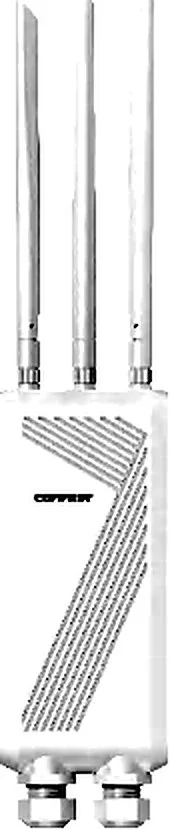
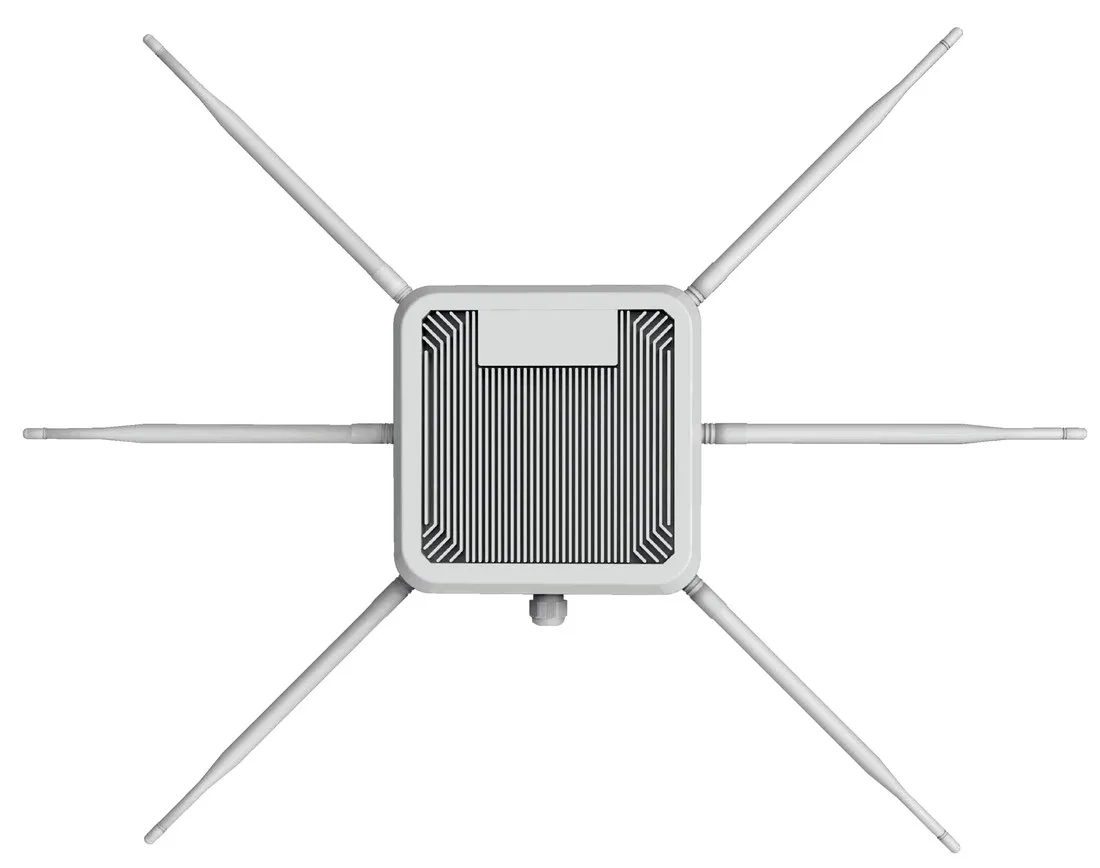
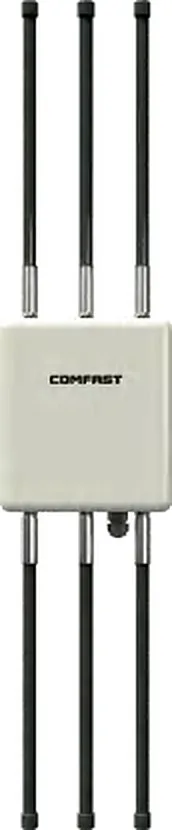
Product pages leave range out because range is not a property of the product. CF-WA937 publishes 3000Mbps, Wi-Fi 6, six external 8 dBi antennas, IP67, 48V PoE and under 24W. Those are the inputs to a link budget; the output belongs to your site, its obstacles, mounting height, crowd size and the transmit power local rules allow.
That is also why a quoted kilometre rarely survives a second look: real coverage is the case where antenna gain, transmit power, path loss and client sensitivity add up to a working link in both directions, not the number on a flyer.
- Trees: foliage holds water and costs 5GHz dearly; halve the planning distance in dense planting
- Crowds: bodies are mostly water, and stands or rallies measure several dB below an empty venue
- Mounting height: too high and the vertical pattern throws energy over the users heads
- Regulation: most markets cap outdoor EIRP, so gain cannot be stacked indefinitely
Which side of the link decides the limit?
The client decides. A phone transmits around 14 dBm into an antenna of near 0 dBi, while the access point feeds 20 dBm or more into 8 dBi of gain. Downlink and uplink are asymmetric, so the usable edge is set by the weaker direction, which is why seeing the SSID has never been a coverage test.
Beacons go out at the lowest modulation and full power, so they are the easiest thing to receive. The moment a phone uploads a photo, a barcode gun reports stock or a handheld submits an order, the harder direction is in use. That is the familiar site report: full bars, failing business.
| Link type | Antennas at each end | Planning distance (engineering range) | Типовое применение |
|---|---|---|---|
| AP to phone or tablet | External 6 x 8 dBi at the AP, about 0 dBi in the handset | 150 to 300 m in open line of sight | Plazas, campsites, campus paths, front rows |
| AP to handheld or scanner | External AP antennas, short handheld antenna close to the body | 80 to 150 m | Yards, loading docks, racking aisles |
| Directional CPE to CPE | Directional at both ends, aimed at each other | 1 to 5 km with clearance | Between buildings, gates, camera backhaul |
How high should an outdoor access point be mounted?
For omni coverage of people standing or walking, 4 to 6 metres on a pole works best. Higher is not farther: past about 10 metres the vertical pattern of an omni antenna puts most of its energy to the sides and above, and the ground directly below weakens. That is the dark spot under a tall pole.
When height is unavoidable, use a sector or panel antenna with downtilt: common practice adds about five degrees of downtilt per five metres above the ten-metre mark, putting the main lobe back onto the people. Aim it wrong and extra gain only sends energy into empty air.
- Plaza, campsite or field centre: omni on a 4 to 6 m pole
- Tall car-park masts: stay off the 12 m and above bracket, use directional units at luminaire height instead
- Long platform or concourse: sector units along one side with the lobe running down the concourse
- Building to building and gate links: directional CPE at both ends, height set by the Fresnel zone
Which model matches your site geometry?
The choice is not about which unit is most powerful but about whether antenna pattern and cell size match the site. The table lists what our outdoor product pages publish, with rate, antennas, protection class and consumption taken as-is; where a value is not published we do not estimate it, ask for that model datasheet.
| Модель | Rate and band | Антенны | Protection and power | Where it fits |
|---|---|---|---|---|
| CF-WA700 | 300Mbps, 2.4GHz | External 2 x 8 dBi | IP67, <8W, 48V PoE | Sparse far points carrying sensors and low-rate traffic |
| CF-WA860 | 750Mbps, 2.4/5.8GHz | External 6 x 6 dBi | IP67, <18W, 48V PoE | Mid-range points where link stability beats headline rate |
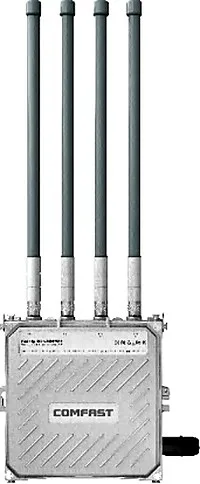
| CF-WA800 V3 | 1200Mbps, 2.4/5.8GHz | External 4 x 8 dBi | IP67, <24W, 48V PoE | Few points with wide reach, gain first |
| CF-WA937 | 3000Mbps, Wi-Fi 6 | External 6 x 8 dBi | IP67, <24W, 48V PoE, 2.5G uplink | Multi-point sites where the uplink saturates first |
| CF-WA933 | 3000Mbps, Wi-Fi 6 | Built-in 5 x 4 dBi | IP66, <18W, 48V PoE or 12V DC | Compact housing where short cells are wanted |
| CF-EW87 | 3600Mbps, 802.11be | External 3 x 5 dBi | IP67, <18W, 48V PoE or 12V DC | Dense new-protocol clients where small cells are possible |
| HW-621G-ME-01 | 3000Mbps, Wi-Fi 6 | External 6 x 7 dBi fibreglass omni | IP67, 48V PoE up to 100 m, 200+ clients | A single point that must hold a larger crowd |
How do you size a stadium or a seating bowl?
A seating bowl is a capacity design, not a coverage design. Tens of thousands of clients at once absorb signal and flood the air with probe requests, and a large cell tuned for reach jams outright. Common planning ranges run 50 to 100 seats per AP under-seat and 150 to 200 seats per AP from catwalk or roof with directional antennas.
Three companions matter more than the count and get missed more often: 20 MHz channels on 5 GHz in the bowl, because wide channels cut the pool; 2.4 GHz switched off in the bowl and kept for back-of-house devices; and a wired run to every access point instead of wireless mesh as the backbone.
To be clear about scope, our outdoor units are pole and wall mount designs for the plazas, security lanes, car parks and concourse around a bowl, not under-seat microcell hardware. A point schedule inside the bowl needs the seat map, structural heights and crowd model reviewed with us, and the datasheet of the chosen unit governs.
What changes in a yard, port or container terminal?
Metal and movement. Stacked containers and racking reflect, absorb and shadow the signal, and every vehicle that moves changes where the reflections come from. Here the planning unit is the lane, not the square metre: place points along lanes, mount on the light masts, and keep cells small enough that a handheld can answer from any point in that lane.
Outdoor power and surge protection belong in the same budget. Most of our outdoor units run 48V PoE, and the HW series product page states PoE up to 100 metres; beyond that, move to fibre or local power instead of stretching the cable. Salt spray, lightning risk and earthing follow the local climate and code, so ask for the datasheet when the housing details matter.
How do you prove the design before ordering?
Survey twice: once on paper, once on foot. Model the site from the plan to fix pole positions and headings, then walk it with a meter, accepting primary coverage of at least -67 dBm and signal-to-noise of at least 25 dB, and run an upload test at the edge of every cell. A download-only test hides the half of the link that fails first.
Agree the count after the walk test: if coverage is short, add points or change the antenna pattern; if interference is high, cut power, shrink cells and replan channels. Discovering this after installation costs a second lift and a rework.
- A scaled site plan marking light masts, buildings, trees and storage zones
- Available mast heights and power at each position
- Crowd size and traffic type: scanning, voice, video or camera backhaul
- Target market and certifications, which decide the model and the label
Часто задаваемые вопросы
Can one outdoor access point cover a 10,000 square metre yard?
In the open with few obstacles and browsing traffic, a unit with 8 dBi external antennas covers a 150 to 300 m radius, which reaches across a 10,000 square metre yard measuring about 100 by 100 metres. Once containers, racking, trees or vehicles are in the way, split the site by lane; scanners and handhelds are harder than phones, so shorten the planning distance.
Does higher antenna gain always mean better coverage?
Gain squeezes energy into a narrower angle rather than adding power. A narrower horizontal pattern reaches further, and the vertical pattern narrows with it, so on the same pole the higher-gain unit is weaker directly underneath. Decide first whether the site is a long strip in one direction or needs coverage all round.
Is IP67 enough for a coastal or chemical site?
IP67 covers dust and temporary immersion, not salt spray or chemical attack. Coastal sites, chemical plants and cold stores need the housing material, salt-spray rating and mounting orientation confirmed separately, with earthing and surge protection designed in. Those details are in the model datasheet, so ask for it rather than inferring them from the IP number.
Can PoE power an access point 200 metres away?
A standard Ethernet channel is 100 metres, and the HW series product page states 48V PoE up to 100 metres. Longer runs need local DC power at the far end, fibre with local power, or a wireless bridge instead of the copper. Simply extending the cable brings voltage drop and an unstable link.
Should an outdoor site move to 6 GHz?
Start with local rules: many markets allow only the low-power class outdoors on 6 GHz, which changes both reach and cell shape. Our outdoor range is mainly dual-band 2.4 GHz and 5.8 GHz, with 802.11be support published for CF-EW87. Band capability and power follow the model datasheet, and we confirm the configuration allowed in your country.